

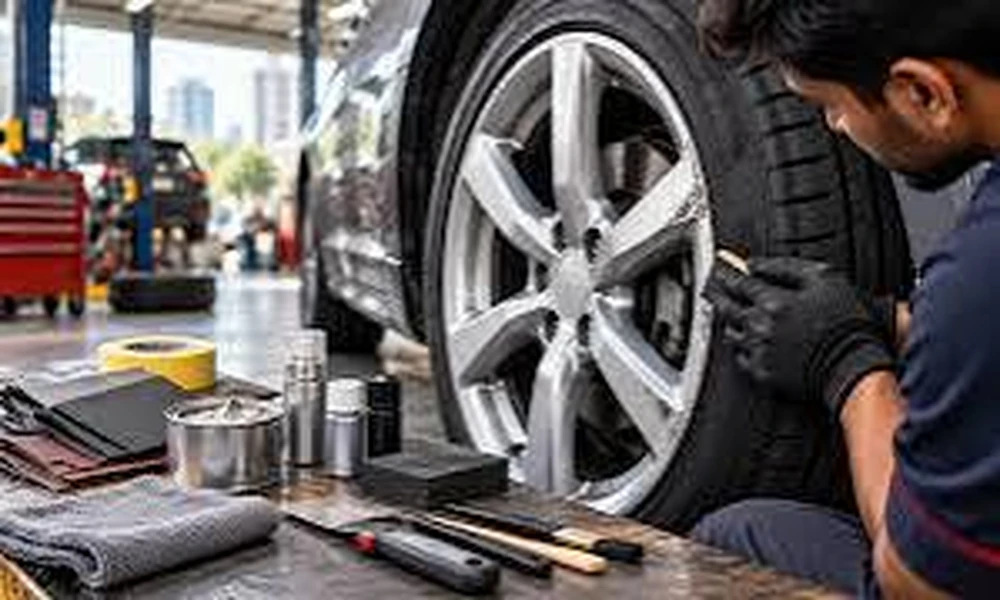
If the worn tires you intend to discard are still mounted on rims you want to keep, settle what happens to the rims before surrendering the assemblies. A collection site’s acceptance of tires on rims does not establish that it will remove the tires and return your wheels. In Mississauga, arrange appropriate professional tire handling and check the actual collection route before moving the set.
This is one set with a mixed outcome: the rubber is being retired while the metal wheels are intended for further use after assessment and any agreed work. An instruction to “take the old wheels for recycling” can misrepresent that intention. Describe the components and the outcome precisely so the whole assembly is not handed over when only the tires were meant to leave.
Identify the rims that need to come back
When booking the Mississauga refinishing service with Onyx Rims, explain that worn tires are still attached to the rims you hope to retain. Agree what tire handling is included and whether the removed tires will be returned to you or handled through another confirmed arrangement. This makes the intended wheel restoration and the tire-disposal task parts of one understandable component plan.
Do not assume that a disposal location provides a removal-and-return service because it accepts mounted tires. Ask directly what will happen to the metal rims if you hand over the assemblies. If retaining them requires professional separation first, arrange that work with a qualified provider. Confirm any charges and practical requirements rather than expecting a collection attendant to improvise a workshop service.
Keeping a wheel remains subject to its actual suitability. If a condition issue is unresolved, obtain the appropriate assessment before treating cosmetic restoration as settled. The useful distinction is between the tires you have decided to relinquish and the rims whose future use is still being professionally considered. Do not perform tire removal or damage assessment yourself to prepare a disposal load.
Peel excludes these items from curb and CRC collection
Peel’s special-item waste sorter lists tires, wheel rims and wagon wheels as neither collected at the curb nor accepted at Peel Community Recycling Centres. It directs residents toward the relevant retailer or service provider for disposal information and tire collection sites. Check that actual entry rather than assuming anything made partly of metal belongs in a general recycling load.
This matters when a household already plans to visit a CRC with other material. The trip can be appropriate for those other items while still being the wrong destination for the wheel set. Separate the loads according to the receiving locations’ rules. A full vehicle and an approaching closing time are inconvenient places to discover that the intended drop-off does not accept what you brought.
Do not transfer instructions from another municipality’s collection programme. A relative may have used a different facility successfully, but that does not change Peel’s stated exclusions. Use the guidance for your actual location and the actual receiving site. If the material or circumstances do not fit the published category clearly, ask the authority for clarification before leaving home.
State exactly what you will bring after the professional handling is agreed. Loose tires and complete tire-on-rim assemblies are different descriptions, even though both may be called “old wheels” in conversation. Identify the tire type and quantity, and explain whether any metal wheels are included. A confirmation then concerns the load that will actually arrive.
A tire collection site can accept tires on rims
The Resource Productivity and Recovery Authority’s tire collection-site guidance says qualifying sites must accept eligible tires free of charge, including tires still attached to rims. Its requirements also address public access, quantity and the type of tires accepted. This collection requirement is separate from any professional tire-removal and wheel-return service you arrange. Every automotive business is not automatically a collection site.
For a non-municipal collection site, RPRA describes minimum acceptance related to tires of a similar rim size and calculated weight to those supplied or provided there, including up to ten per day from a person. It describes different minimums for municipal and certain other sites. Confirm which receiving site you intend to use and whether your actual tire type and quantity fall within its collection arrangements.
The on-rim requirement is useful for someone surrendering a complete assembly. It does not answer the different question of getting the same metal wheel back. If the rims are being kept, resolve that service and ownership question before drop-off. Do not cut, pry or attempt to separate a mounted tire yourself to avoid the conversation. Have the appropriate provider handle any required separation.
Bare metal rims need their own confirmed answer. Acceptance of tires on rims does not by itself establish that a particular tire collection site accepts a load consisting solely of wheels. Likewise, a site’s acceptance of passenger tires may not resolve a question about unusual or oversized items. Ask about any conditions or charges for items or services outside the free eligible-tire collection requirement.
Hand over only what you intend to relinquish
Before loading, confirm the receiving location, access hours, accepted item description and quantity. Check whether an appointment or another arrangement is needed. Plan safe transport appropriate to the items and your vehicle, and obtain help if you cannot handle them safely. Do not leave a load outside a closed site or an unrelated business simply because it normally deals with tires.
At the handover, make sure the load matches the agreement. If the intended outcome is disposal of loose tires after professional removal, the rims should remain with you or the agreed service provider. If you are surrendering an assembly and expect its wheel back, that return must already be confirmed. Accepting an item for collection and providing a wheel-return service are different commitments.
The successful outcome is specific: the tires you meant to discard reach an appropriate collector, while the rims you meant to keep remain available for the agreed assessment or refinishing. That outcome starts before drop-off, with a clear answer about what will be relinquished and what must come back.
