

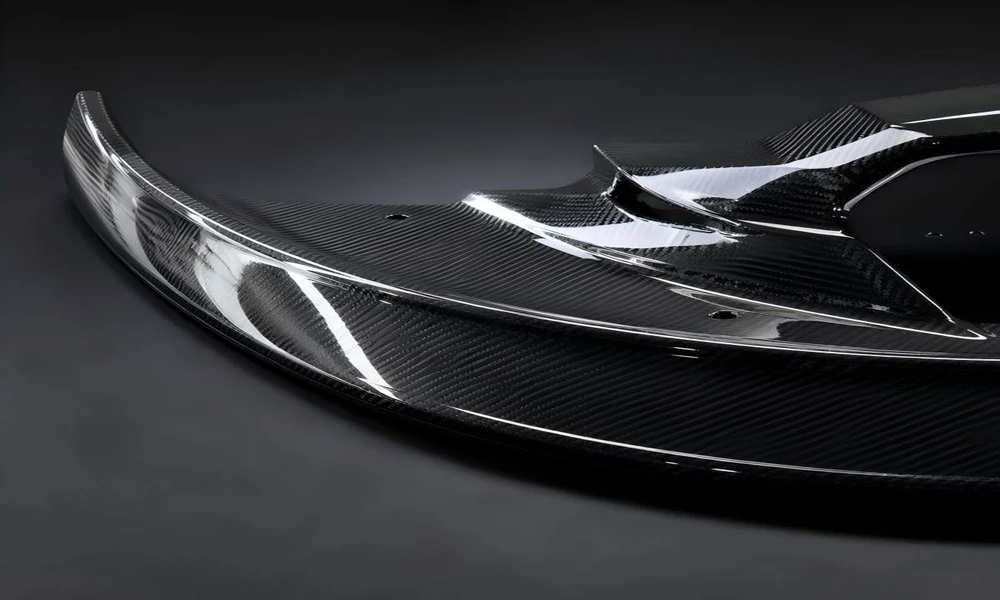
Not quite black. Never just black.
Here is a question that sounds stupid until you try to answer it: what color is carbon fiber? Black, obviously. Except hold a part next to a true black object and the carbon reads as a very dark gray. Move it into sunlight and silver threads appear. Tilt it and the whole surface shifts. The honest answer is that carbon fiber has a color code, around #262626 in digital terms, and a behavior that no color code can capture.
The Number: #262626
Designers who need to mock up carbon parts use roughly #262626, a near-black with a breath of gray in it. That is the base tone of raw carbon weave under neutral light. But treating carbon as a flat color is like describing water as ‘blue, sometimes’, technically defensible, practically useless. The weave is a three-dimensional texture made of thousands of tiny fiber bundles, and texture interacts with light in ways flat color never does.
Why It Shimmers
Each carbon filament bundle is a cluster of cylindrical fibers, and cylinders reflect light directionally. In a woven fabric, bundles cross each other at right angles, so at any given angle of view, some bundles catch the light and some swallow it. Move your head and the pattern flips. That is the famous carbon shimmer, and it is why the material looks alive in a way that no printed or painted imitation has ever matched. It is also why the carbon fiber color guide treats finish and weave as part of the color decision, on this material, they are.
The Light Changes Everything
Under overcast sky, carbon reads as its flattest self: dark gray, subtle, almost matte even under gloss. Under direct sun, the weave ignites. Every bundle becomes a tiny mirror and the part looks half as dark as it did in the shade. Under warm showroom light it picks up brownish depth; under cool LEDs it goes blue-gray. Owners who buy a part from one photo are sometimes surprised by all of this. The part did not change. The light did what light does.
There is a practical upshot for anyone photographing their own car: the same carbon part will give you five different looks in five different lights, and none of them is the true one. Overcast light is the most honest for judging actual tone and weave quality. Golden-hour light is the most flattering and the least truthful. Pick your photo hour according to whether you want documentation or admiration.
What This Means When You Choose
First, never judge a carbon part from a single photo, and be suspicious of sellers who only provide one. Second, think about where the part will live: a roof spoiler seen mostly against sky reads lighter than a splitter sitting in the shadow of a bumper. Third, remember that weave size changes perceived tone. Larger weaves read lighter and busier, tight weaves read darker and calmer. Same fiber, same color code, different visual weight.
Fourth, and most overlooked: the finish multiplies everything. A gloss clear coat deepens the perceived darkness and sharpens the shimmer; matte flattens both. Two parts with identical fabric, one gloss and one matte, can read as two different colors on the same car. Choosing a finish is choosing a shade, whether the catalog admits it or not.
The Neighbor Test
Want to know how dark your carbon really reads? Park the part next to a tire. Tires are true black, carbon black pigment at full concentration, and next to one, every carbon part reveals its gray heart. Window trim and piano-black plastics run the same test. This is not a flaw; it is calibration. Carbon’s near-black tone is exactly why it pairs so gracefully with both black paint and bright colors: it is dark enough to read as black, gray enough to stay soft.
Age moves the tone too. As clear coats take UV over the years, they warm slightly. A barely-there amber shift that softens the black into charcoal. On quality parts the shift is slow and even; on cheap ones it is fast and blotchy. Either way, the color you bought is on a slow journey. Buy the journey you want to be on.
And If Black Is Not What You Wanted
If near-black is not the assignment, the color lives in everything around the fiber: tinted resin, woven-in colored fibers, forged patterns, paint. The ways to change carbon fiber color cover that toolbox in full. But most people who spend time around the real material come back to the base tone. #262626 with a shimmer turns out to be less of a color and more of a behavior. And behavior is harder to get bored of.
So what color is carbon fiber? A dark gray that performs. Specify it like a color and you will be mildly disappointed. Understand it as a light effect with a base tone, and you will choose parts that look right in every season, every light, every photo, including the ones nobody planned.
