

For most car enthusiasts, the fun starts when the vehicle arrives.
Maybe it’s a classic you spent months searching for, a performance car purchased from a seller several states away, a new project car headed to your garage, or simply a vehicle that needs to make a cross-country move without adding thousands of miles to the odometer.
But before that first drive comes another question:
How do you get the car home?
We spoke with Richard Avery, President of Smart Auto Move Inc, about what really happens behind the scenes when a vehicle is transported, what enthusiasts should know before choosing an auto transport company, and why the cheapest shipping quote isn’t always the deal it appears to be.
“People Aren’t Just Shipping Cars”
Me: Car enthusiasts tend to be especially protective of their vehicles. Do you notice a difference when working with someone who really loves cars?
Richard Avery: Definitely. And I understand it.
To someone looking at a computer screen, it might just say year, make and model. But that doesn’t tell you what the vehicle means to the owner.
It could be a car they’ve wanted since they were 16. It could be something they spent years restoring. Maybe they flew halfway across the country to find the right color and options.
People aren’t just shipping cars. They’re shipping something they care about.
Our job is to remember that.
From Online Purchase to Driveway Delivery
Buying vehicles outside your local market has become remarkably normal.
Enthusiasts routinely search nationwide for a specific trim level, unusual color combination, low-mileage example or rust-free vehicle. Online marketplaces, auctions and enthusiast communities have dramatically expanded the number of cars available to buyers.
The challenge comes after the purchase.
Me: Are you seeing more customers buying vehicles long-distance?
Avery: Absolutely.
Years ago, a lot of people limited their search to whatever was within a few hours of home. Now somebody in North Carolina might find the exact car they want in California, Texas or Washington.
They realize that spending money on transportation can make more sense than settling for the wrong vehicle locally.
It’s especially true with enthusiast cars because the buyer usually knows exactly what they’re looking for.
What Actually Happens After You Book Auto Transport?
For someone who has never shipped a vehicle, the process can seem mysterious.
According to Avery, it doesn’t have to be.
Me: Walk us through a typical shipment.
Avery: Once the transport details are confirmed, the objective is to match the vehicle with the right carrier running that route.
Before pickup, the customer needs to make sure the vehicle is accessible and ready for transportation.
When the driver arrives, the vehicle is inspected and its condition is documented. The car is loaded onto the transporter, secured and then transported toward the destination.
At delivery, another inspection is performed before the customer accepts the vehicle.
The physical transportation is pretty straightforward. The complicated part is coordinating schedules, equipment, routes, weather, traffic and communication so everything comes together correctly.
Does Smart Auto Move Ship Everywhere in the United States?
Me: Does Smart Auto Move ship everywhere in the U.S., and what would you consider the company’s strongest routes?
Avery: We ship vehicles throughout the continental United States, with the exception of Alaska. We also don’t ship vehicles to Hawaii or Puerto Rico.
As far as our strongest routes, we can arrange transportation to and from any state in the continental U.S., but naturally we tend to move more vehicles through the areas where we have our main hubs.
Those hubs are in Lakewood, Washington; Kissimmee, Florida; Los Angeles, California; and Chicago, Illinois.
Because of the volume we handle in those regions, we have multiple weekly shipments on a number of major routes.
Some of our busier lanes include California to Texas, Texas to Illinois, Florida to California, Northeast states to Florida, Washington to Florida, and many others.
The advantage of having regular volume on those routes is familiarity. We know the lanes, we know where the carrier traffic tends to be strongest, and we have a good understanding of what realistic pricing and transit times should look like.
But we’re definitely not limited to those routes. If someone needs to move a vehicle from one side of the country to the other, or between two smaller markets, we can help arrange that transportation as well.
Open Carrier or Enclosed Transport?
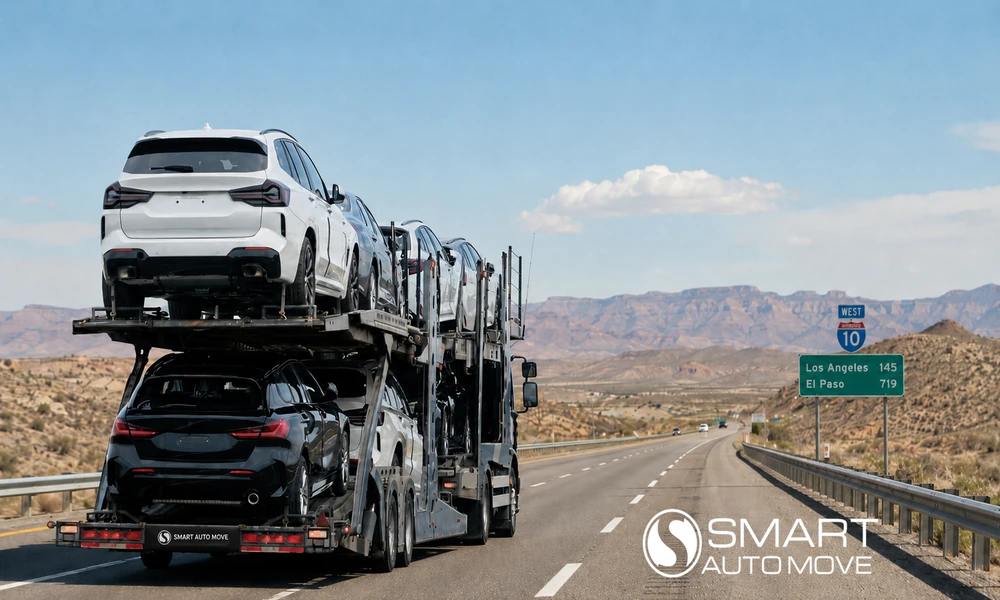
Anyone who has driven on an interstate has seen the familiar multi-level open auto transport trailers carrying vehicles across the country.
For most vehicles, Avery says open transport remains the most practical choice.
Me: Enthusiasts often wonder whether they need enclosed shipping. How should someone decide?
Avery: Open transport is how the overwhelming majority of vehicles are moved, including new vehicles.
For a normal daily driver, SUV, pickup or even many performance cars, open transport can make perfect sense.
Enclosed transport becomes more attractive when you’re talking about something extremely valuable, rare, collectible or a vehicle where the owner wants additional protection from road debris and weather exposure.
There isn’t one answer for everybody.
The important thing is choosing the transportation method based on the vehicle instead of assuming the most expensive option is automatically necessary.
The Problem With Extremely Cheap Car Shipping Quotes
Auto transport pricing can be confusing.
A consumer may request several quotes for exactly the same vehicle and route and receive dramatically different prices.
According to Avery, that should immediately raise questions.
Me: Why can one company quote hundreds of dollars less than another company?
Avery: Sometimes a company gives a low number because they know that’s what gets the customer to book.
But there’s still a real market price required to get a qualified carrier to transport that vehicle.
If the original quote is unrealistic, eventually somebody has to deal with that difference.
And unfortunately, that can happen after the customer has already made plans around the shipment.
The cheapest quote isn’t necessarily the cheapest shipment.
Why Smart Auto Move Created Its Smart Price Promise
Pricing uncertainty is one of the reasons Smart Auto Move introduced what the company calls its Smart Price Promise™.
The idea is straightforward: once transportation is confirmed, customers shouldn’t suddenly encounter unexpected price increases when the vehicle, route, condition and shipping details haven’t changed.
Me: Why was making that promise important?
Avery: Because people need to make plans.
Maybe they’re flying somewhere to meet the vehicle. Maybe they’re relocating. Maybe a seller needs the car picked up before a deadline.
If someone thinks transportation costs one amount and then suddenly gets told something different at the last minute, that creates a problem much bigger than shipping.
We want customers to understand what they’re agreeing to and have confidence in the transportation arrangement.
Timing Matters Almost as Much as Price
For many customers, Avery believes the pickup and delivery schedule is more important than saving a relatively small amount of money.
Me: What causes transportation delays?
Avery: A lot of things can affect timing.
Weather is a big one. Traffic accidents and road closures happen. Trucks can experience mechanical problems. Previous customers sometimes delay a driver’s schedule.
Route density matters too.
A carrier traveling between Los Angeles and Dallas has a lot more opportunities than one servicing two small towns far away from major highways.
That’s why we try to give realistic expectations instead of pretending every shipment works on an exact clock.
Why Pickup Location Matters
Enthusiasts purchasing vehicles online can sometimes make transportation easier simply by understanding geography.
A vehicle sitting close to a major interstate or metropolitan area is generally easier for a transporter to access than one located far from common trucking routes.
Me: Can location affect both price and pickup speed?
Avery: Very much.
Transporters want efficient routes.
If a driver can pick up several vehicles around a metropolitan area without driving hundreds of empty miles, that route becomes more attractive.
If the car is located far outside those lanes, the carrier has to account for that additional mileage and time.
Sometimes moving the pickup or delivery point even a short distance can make transportation easier.
Preparing Your Car for Shipping
Fortunately, vehicle preparation usually isn’t complicated.
Avery recommends making sure the car is operable unless it was specifically booked as an inoperable vehicle, checking for obvious fluid leaks, removing loose valuables and making sure the transporter has access to the vehicle.
Smart Auto Move allows up to approximately 100 pounds of personal belongings, provided they are kept below the window line and are not visibly exposed.
Me: What is one thing people forget before the transporter arrives?
Avery: Keys.
It sounds obvious, but it happens.
People also forget about low ground clearance, dead batteries or modifications that might affect loading.
If the vehicle has something unusual about it, tell the transport company beforehand.
It’s much easier to prepare the right equipment than discover the issue when the truck arrives.
Modified and Performance Cars Require Extra Attention
That advice is particularly important for enthusiast vehicles.
Lowered suspensions, aftermarket splitters, wide-body kits and oversized wheels can change how a vehicle needs to be loaded.
Me: Should someone mention modifications even if the car still drives normally?
Avery: Absolutely.
Ground clearance is probably the biggest one.
A transporter needs to know if the vehicle is extremely low because loading angles become important.
The same applies to oversized vehicles or trucks with major suspension modifications.
Information helps prevent problems.
Never assume something isn’t worth mentioning.
The Human Side of Car Shipping
Despite all the technology surrounding transportation today, Avery believes communication remains one of the biggest differences between a good experience and a bad one.
Me: What do customers want most once their car is in transit?
Avery: They want to know what’s happening.
That’s really it.
If someone hands over the keys to a vehicle worth $40,000, $80,000 or more, they’re naturally going to think about it until it arrives.
Even if everything is going perfectly, communication matters.
Most frustration comes when somebody doesn’t know what’s going on.
A Business Built Around Moving Cars – and Expectations
Smart Auto Move coordinates vehicle transportation throughout the continental United States, working with customers shipping cars, SUVs and pickup trucks between major markets and smaller communities.
The company handles everything from everyday family vehicles to enthusiast purchases and long-distance relocations.
For Avery, however, the philosophy behind the company remains fairly simple.
Me: After years in this industry, what do you think separates a good auto transport company from the rest?
Avery: Doing what you said you were going to do.
Anybody can build a website and put a cheap number on the screen.
The hard part is answering the phone, communicating when something changes, pricing transportation realistically and staying involved until the vehicle gets delivered.
That’s what customers remember.
Richard Avery’s Advice for Anyone Shipping a Car
Before ending our conversation, we asked Avery what advice he would give an enthusiast preparing to ship a vehicle for the first time.
His answer was surprisingly simple.
Avery: Don’t choose a company based on price alone.
Ask questions.
Find out who’s actually going to communicate with you after you book.
Make sure the company understands the vehicle you’re shipping.
And if a price looks dramatically cheaper than everything else you’re seeing, ask yourself why.
You spent time finding the right car.
Take a little time finding the right company to move it.
The Journey Before the Drive
Car enthusiasts will probably never get excited about transportation logistics in quite the same way they get excited about horsepower, suspension setups or the sound of a great engine.
But when the car you’ve been searching for is sitting 2,000 miles away, transportation suddenly becomes a very important part of the ownership experience.
For Smart Auto Move Inc, that responsibility begins before the transporter arrives and doesn’t end until the vehicle reaches its destination.
As Avery puts it:
“You’re trusting somebody with your vehicle and your plans at the same time. We take both seriously.”
For enthusiasts searching nationwide for their next vehicle, that might be the most important thing to remember before clicking “buy.”
To get a hold of Smart Auto Move, you can call 888-709-9078.
